
New RASB White Paper: Why We Call It Risk Accounting
Measuring the Missing Present
The Risk Accounting Standards Board has published a new white paper, Why We Call It Risk Accounting: Measuring the Missing Present.
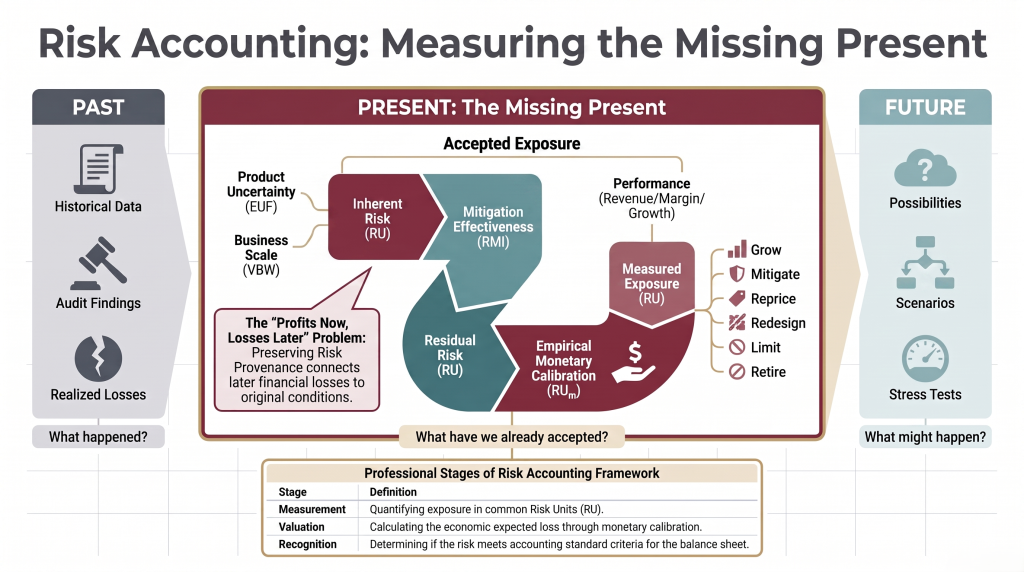
Risk management is well equipped to look backwards. Loss databases, incidents, audit findings and historical experience tell institutions what has already happened.
It is also becoming increasingly sophisticated at looking forwards. Scenario analysis, emerging-risk identification, stress testing, KRIs and predictive analytics seek to understand what may happen next.
But between the past and the future sits a less well measured question:
How much non-financial risk is the business carrying now?
That is the “missing present” examined in this paper.
Risk Accounting was developed around the proposition that operational and other non-financial risk should be connected directly to the business activity from which it arises. Rather than waiting for losses to materialise, the method seeks to quantify the exposure generated by current activity, assess the effectiveness of mitigation, and derive the residual risk that remains.
This creates a different perspective on risk measurement.
Business activity generates exposure. Controls and operating practices mitigate that exposure to varying degrees. The remaining residual risk can therefore change not only when controls improve or deteriorate, but also as volumes, products, processes and the scale of the underlying business evolve.
The paper explores why this approach was described as Risk Accounting, and revisits the vision developed by Peter J. Hughes of bringing risk measurement closer to the disciplines of accounting and business performance.
Among the questions considered are:
- Why do conventional risk frameworks measure realised losses and future scenarios more readily than the risk being carried in the present?
- Can non-financial risk exposure be measured in a consistent unit before loss occurs?
- How can inherent or pre-mitigation exposure be separated from the effectiveness of controls?
- Can residual risk be related to business volumes and incorporated into risk-adjusted profitability and management decisions?
- What could such measurement contribute to control investment, risk appetite, incentives and accountability?
- How should measurement, monetary valuation and eventual accounting recognition be distinguished?
- What empirical testing and calibration would still be required before the approach could support broader financial-reporting applications?
The paper also revisits an important asymmetry in modern financial reporting. Expected credit losses are recognised through established accounting frameworks, while expected losses arising from operational and other non-financial risks generally lack an equivalent measurement architecture.
Risk Accounting does not assume that solving the measurement problem automatically solves the questions of valuation or accounting recognition. Instead, it proposes that credible measurement of the underlying risk exposure is the necessary place to begin.
The central proposition is simple:
Risk management can describe what happened and imagine what might happen. Risk Accounting seeks to measure the risk the business is carrying today.
By making that present exposure visible, comparable and responsive to changes in both business activity and operational effectiveness, Risk Accounting aims to turn non-financial risk from a largely retrospective or scenario-based discipline into a measurable part of day-to-day business management.