
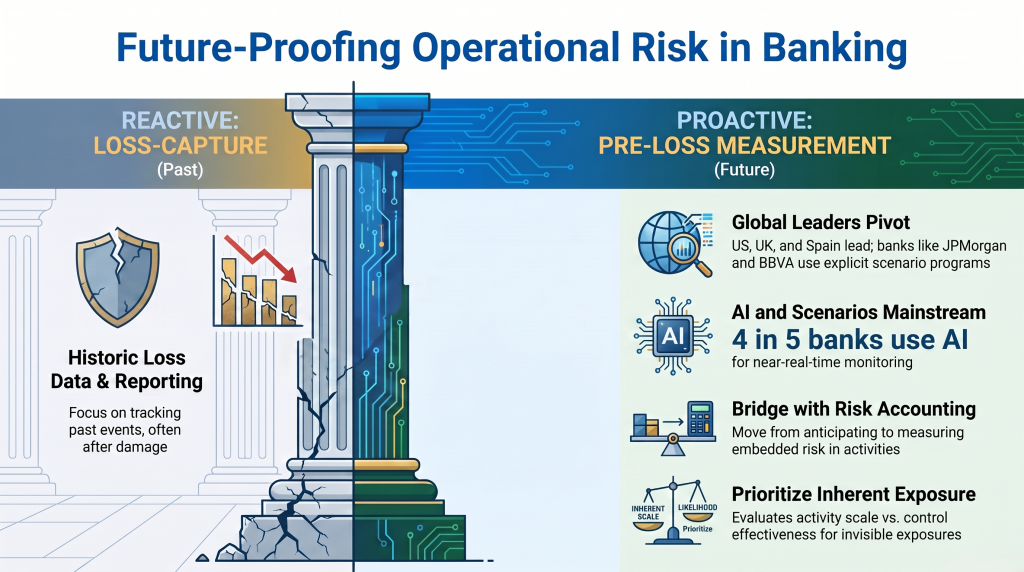
New RASB White Paper: "Operational Risk Before the Loss"
The Risk Accounting Standards Board has published a new white paper, Operational Risk Before the Loss: From Forward-Looking Practice to Pre-Loss Measurement.
Operational risk management is visibly moving beyond its historically backward-looking foundations. Banks and other financial institutions are investing in scenario analysis, emerging-risk identification, predictive key risk indicators, operational resilience testing, stress testing, continuous control monitoring, and AI-enabled analytics.
These practices improve anticipation, detection, challenge, and preparedness. However, they do not always provide a consistent measure of the operational risk already embedded in business activity before a loss occurs.
The white paper examines this measurement gap and introduces a critical distinction:
- Anticipation asks what could happen.
- Detection asks which signals are deteriorating.
- Measurement asks how much risk is being carried now.
Risk accounting is presented as a pre-loss measurement discipline. It does not attempt to predict a specific operational-loss event or the date on which it will occur. Instead, it measures the present operational conditions that make future losses more or less likely, more or less severe, and more or less preventable.
The paper explores:
- why historical loss data is necessary but insufficient;
- how inherent exposure, mitigation effectiveness, and residual risk can be assessed before loss;
- why potential loss depends on scale, business activity, process criticality, and control quality—not only probability;
- how some apparent “tail events” may represent the late manifestation of accumulated and previously invisible exposure;
- why regulatory compliance is necessary but not equivalent to operational safety;
- how pre-loss measurement can strengthen scenario analysis, KRIs, RCSA, operational resilience, board reporting, remediation prioritisation, and supervisory dialogue;
- how operational-risk management can protect and create business value through better decisions and more effective allocation of control investment.
The paper also proposes a research and pilot agenda covering taxonomy testing, best-practice calibration, cross-bank benchmarking, linkage to incident and loss data, integration with KRIs and scenarios, governance, auditability, and board usefulness.
The central conclusion is straightforward:
The industry has already taken an important step by embracing forward-looking thinking. The next step is to make that thinking measurable, consistent, and actionable.